
“A Different Kind of War Film: The Ethos of the Individual Soldier in The Hurt Locker”
by Mikal Lambdin | Xchanges 11.2
“With Me I Think It’s One”: Man Over Machine Cont.
James’s most compelling moment of vulnerability comes at the very end of the film, after he has returned home to his family. In this scene, he entertains his young son with a jack-in-a-box, and finally confronts the truth:
JAMES. You love playing with that. You love playing with all your stuffed animals. You love your Mommy, your Daddy, your nature pajamas. You love everything, don’t you? Yeah. But you know what, buddy? As you get older, some of the things you love might not seem so special anymore, you know. Like your jack-in-a-box. Maybe you realize it’s just a piece of tin and a stuffed animal. And the older you get, the fewer things you really love. And by the time you get to my age, maybe it’s only one or two things… With me, I think it’s one.
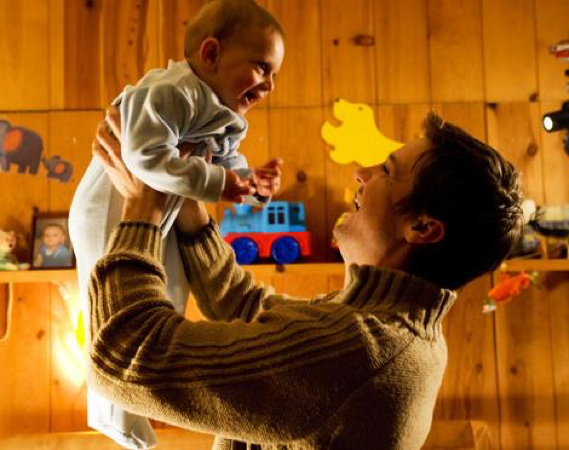
The poignant vulnerability that James displays is both unexpected and arresting. In the moments before his final speech, he happily bounces his infant son on the bed — he is no longer the hardened war addict. For just this moment, he is a loving and gentle father who is contented to sit in a nursery and play games with his son. There is almost a hint of envy in his voice as he chuckles, “You love everything, don’t you?” This is where his tone changes. James begins to grow thoughtful, and suddenly becomes strikingly grave as he reveals: “And the older you get, the fewer things you really love.” His last, honest confession is a perfect paradox of acceptance and remorse: “With me, I think it’s one.”
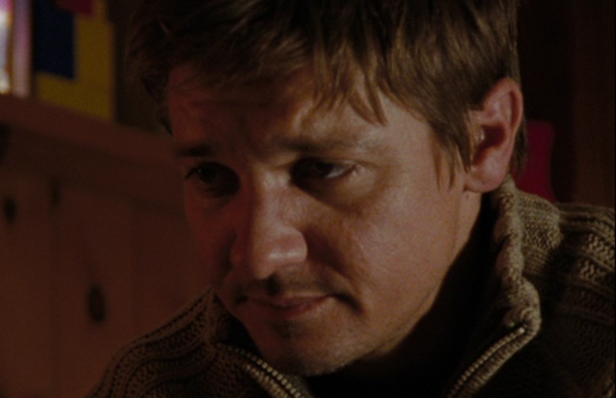
Here, at the very close of the film, James lets the curtain fall ever so slightly, allowing the audience to see what hides behind it. In the safety of his son’s nursery, he faces the truth, openly acknowledging his addiction for the first time. He does not take pride in his addiction, neither does he make any promises to change. He simply offers the truth: there is only one thing he truly loves. Yet, through the very act of making this honest confession, James reveals that it is not fully accurate. The joy on his face as he plays with his son is real, as is the pain that follows. James does love his son. Perhaps he just doesn’t love him enough.
This scene works in two key ways to establish James’s ethos as human. 90 percent of the time, James is aloof, brave, and reckless, yet it is essential that he be more than this. He is also a father who loves his son, if imperfectly. He knows how to put a baby to sleep. He feels simple joys. He feels remorse. He even recognizes his addiction to war. Yet, simply having a heart does not redeem him. At the end of it all, he is seen stalking through Iraq’s dusty streets, encased in a bomb suit, at the start of another 365-day rotation. James’s unredemptive vulnerability is a powerful aide to his ethos as a human being who cannot be categorized as good or bad. Like any other human being, he is both and neither, all at once.