
“A Different Kind of War Film: The Ethos of the Individual Soldier in The Hurt Locker”
by Mikal Lambdin | Xchanges 11.2
“I Don’t Know”: Leaving Things Out
Throughout the film, James has many opportunities to bare his soul in true Hollywood fashion. Several scenes seem targeted as moments of reveal, promising to answer weighty questions about James’s hidden thoughts and experiences, only to leave these questions unanswered. His anonymity is a powerful rhetorical tool that increases his ethos by making him complex and believable. The moment of reveal is a common film cliché — contrary to this oft-used cliché, James does not open his heart at precisely the right moment, finding the perfect words to express his thoughts and feelings. He is guarded and awkward and rarely wants to reveal himself, even when he knows how. He disappoints audiences, but this disappointment is not an unfortunate byproduct — it is necessary. The viewers’ disenchantment itself sends an important message: James is not a hero or the model soldier; he is just a person.
James’s anonymity is on display in a scene toward the middle of the film, when fellow soldier Sergeant JT Sanborn finds a box of his possessions. The conversation quickly turns to his son and wife, but James offers little information:
SANBORN. [looking at a photo] Who’s that?
JAMES. That’s my son. He’s a tough little bastard. Nothing like me.
SANBORN. You mean to tell me you’re married?
JAMES. Well, you know, I had a girlfriend and, uh, she got pregnant. So we got married, we got divorced. Or, you know, I thought we got divorced. I mean, she’s still living in the house and she says we’re still together, so I… I don’t know. Wha-what does that make her? I don’t know…
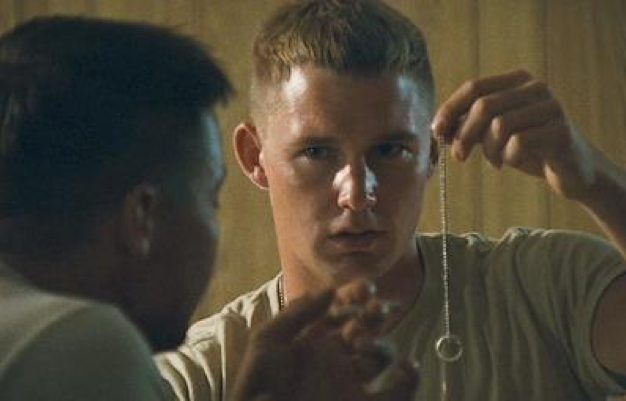
Here, James fumbles, contradicts himself, and hesitates repeatedly as he avoids revealing details about his familial relationships. He first describes his son as a “tough little bastard,” making him “Nothing like” James, a statement which is pointedly contradictory. “Tough bastard” is a fitting description of James, the experienced, war-hardened soldier. By giving his dissociated son a description that better fits himself, James avoids confronting both his fellow soldiers and the audience with his true identity.
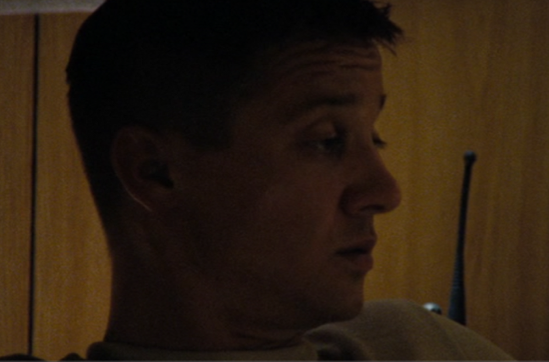
James pauses uneasily before answering, and when he finally does, his speech is peppered with detracting phrases, including “uh,” “you know,” “I mean,” and “I don’t know.” There is hardly a breath between “we got married” and “we got divorced,” as if nothing occurred between the two events. His repetition of “I don’t know” is perhaps emblematic of the whole scene — a weak attempt to feign ignorance about a complex and intimate part of his life. Regardless of what James is hiding, he is undoubtedly hiding something, and his mysterious relationships with his wife and son are never truly revealed.