
“A Different Kind of War Film: The Ethos of the Individual Soldier in The Hurt Locker”
by Mikal Lambdin | Xchanges 11.2
“With Me I Think It’s One”: Man Over Machine
James’s moments of vulnerability are few and fleeting, and yet they are an utterly essential part of his rhetorical make-up. Without this vulnerability, his anonymity and detachment would be overbearing and ineffective, stripping him of his ethos as an individual and turning him into another cliché of masculinity — more machine than man. His anonymity makes him believable, his addiction and resulting detachment make him unique, and his vulnerability ties everything together by making him human.
In one of the more sobering scenes in the film, James discovers a body bomb in a warehouse, claiming that the victim is a young boy he met in an Iraqi market. This is James’s first clear expression of vulnerability, as he tenderly cares for the body before detonating the warehouse.
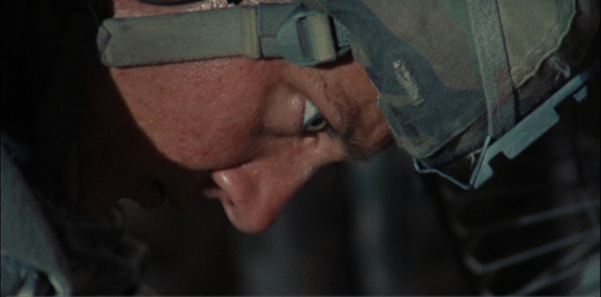
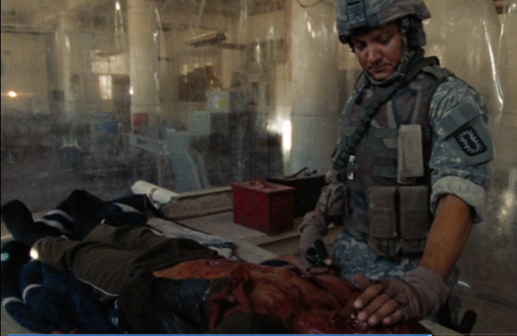
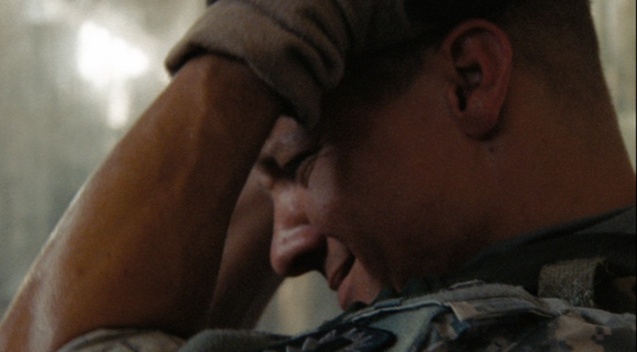
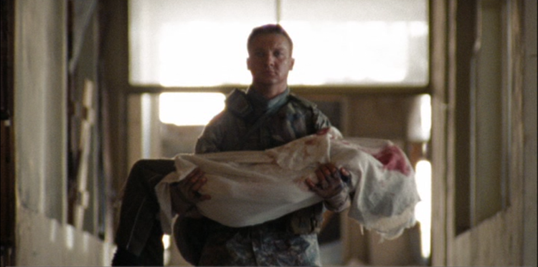
James’s reaction to the body bomb is easily the most powerful display of emotion that he offers in the film. After telling soldiers to prepare to detonate the warehouse, James is left alone with the body. He stares at it for just a moment before walking away, cursing under his breath and choking back vomit. Making a focused effort to regain his composure, he abruptly arranges the C4 on the body, but his hand hovers over the last block, his eyelashes fluttering. Within moments James has removed the C4 and is frantically ordering Sanborn to “cancel the det.” His movements instantly go from rigid and systematic to gentle, as he places a hand over the boy’s face and closes his eyes. James removes his helmet and clenches his fists against his head in a burst of raw emotion. The moment is over as quickly as it began, but this image of James, his eyes closed and tears on his face, is striking. The scene ends with a final, stark shot of James leaving the warehouse carrying the boy’s body, carefully wrapped in a white cloth.
The silence in this scene is palpable, enhancing every action and facial expression. This scene, which occurs just over half way through the film, is critical, allowing the audience to view James as human for the first time. The unshakable soldier is finally shaken, experiencing fear, grief, and even weakness. James may be tough, but he is not indestructible. This scene allows him to bleed just enough to confirm that he is not made of metal, without undermining his detached, war-addicted nature.