“Visualising Affect Using Virtual Reality”
by Polly Card & Michelle Ruiz | Xchanges 12.2/13.1
The Film
The film was shot using a 360 camera. We chose this format to enable each viewer-participant to operate within the scene much like the protagonist’s involvement in real time. We gave each viewer-participant a Google Cardboard headset and set up the film for them. The technology enables the participant to view the scene in a potentially similar way to how transborder students do. Whilst watching the film, participants are immersed in a 360-degree landscape, actively choosing a point of view within the scene. Each experience is like a living and unique organism shaped by each participant (Manovich, 2001). The multimedia experience encourages participants to take an active role; they engage with content and are empowered to explore the experiences from the point of view of a TELLM student.
In the film, experiences and reflections on racial and gender stereotypes of TELLMs are explored in first-person, with a narrative voice-over. We chose a single voice to portray exactly what the character sees and experiences. The script was based on the initial interviews with TELLM students. We chose this approach so participants felt a sense of closeness to the character. A TELLM student was cast in the role, rather than a professional actor, to stay true to the authentic voice of the film. The student narrator was invited to edit the script and make his own suggestions. He identified with the character’s experiences and described the script as “resonating” with him, with many of the scenarios true to his own and peers experience.
The student voice-over directs the narrative. We wanted the viewer-participant to understand what the individual student is experiencing in the hope that they may feel compassion for the student experiencing what the Buddhists call “loving-kindness,” a state in which one actively cares for another.
The narrative is intercut with the voice and graphic elements generated by The Machine, to prompt the audience to question their own ideological clarity. Through the juxtaposition of these narrative voices, the power of the film originates. This is referred to as heteroglossia, “another’s speech in another’s language, serving to express authorial intentions but in a refracted way” (Bakhtin, 1934, p. 324).
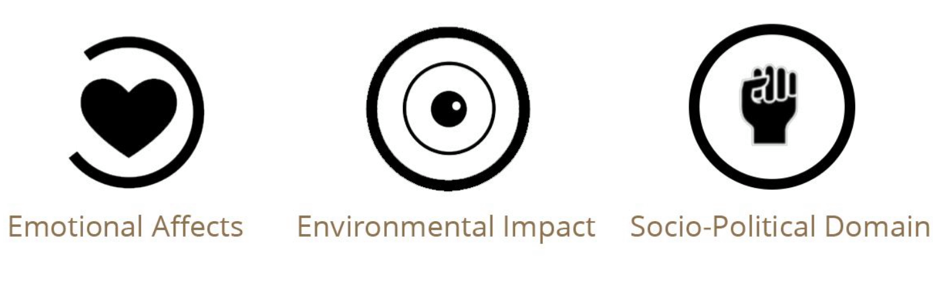
Harris and Wood’s (2016) research shows that certain factors that occur outside of community college influence students’ experience in college. They refer to these factors as existing within a socio-ecological model. We depicted a simplified version of this framework in the film by examining emotional affects, environmental impact, and sociopolitical domain as factors outside of the college environment that influence student experiences. We created icons for each factor which appear in all scenes with information about how they relate to the student’s story.