
“Strengthening Technical Communication with Educational Theory”
by Penny Bencomo | Xchanges 8.1
Computer-Based Learning
Computer-based learning, whether as a supplement to traditional learning or as the main method of educating, is an incredibly flexible tool. At its inception, distance learning was little more than a set of broadcast lectures — one-sided and ineffective for the teacher and the students. This is a large problem, since many teachers and instructional designers that come to distance education from traditional backgrounds bring with them assumptions about teaching and learning that do not translate well to technologically mediated instruction (Jonassen et al. 8). By using activity theory and technical communication principles when planning and designing distance education to create context, the students would learn material much more effectively.
In this context, a more in-depth look at human-computer interaction (HCI) is needed. HCI is an intersection between computer science, behavioral science, and many other disciplines. The Association for Computing Machinery defines HCI as a “discipline concerned with the design, evaluation, and implementation of interactive computing systems for human use and with the study of major phenomena surrounding them.” More simply put, the human and computer alternate the performance of tasks (Gilman).
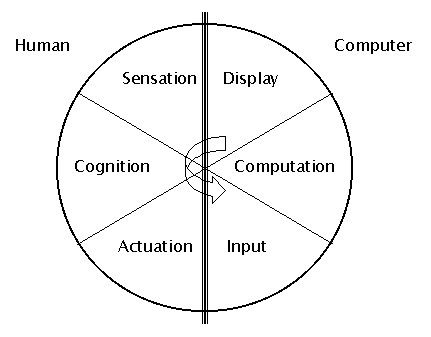
Figure 3 illustrates HCI: The user sees a list of links on the screen (sensation), thinks about which one best suits his or her needs (cognition), chooses that link, and then clicks on it (actuation). The computer then takes the mouse click (input), goes to that link (computation), and then shows the information on the chosen page (display) (Gilman). If the user does not see something he or she is familiar with, doesn’t have the knowledge foundation for cognition, or does not know how to actuate his or her cognition, then the interaction between the human and the computer has failed. Audience awareness is crucial when designing anything that a person will use on a computer.
Using Technical Communication to Improve Computer-Based Learning
Without any knowledge of activity theory or any other education philosophies, technical communicators can clarify confusing language, minimize the amount of text necessary to make a point, evaluate and design user interfaces, and develop help systems for computer-based education. They can determine if the technology is being used appropriately for the application, and if the material is appropriate for the audience. Two very important ways that technical communicators can help refine computer-based education are user-centered design and usability testing.
User-Centered Design
Many textbooks claim that the lacks of clarity, brevity, or syntactic quality are the downfall of effective instructions (Johnson 289). However, if the instructions are written without knowledge of the audience or how the instructions will be used, the instructions may be equally useless. Instructions are often written after the design and development processes are over. Users are not considered at all, and are often reduced to the position of receiver, with no input into document design. If the user is new to this kind of technology or interface, the user is at a disadvantage. The instructional document is often written by an expert, and the document ends up being a description of the technology, not helpful to the user (Johnson 290). This approach is in complete opposition to technical communication principles as well as activity theory.
Workplace learning is another focus of activity theory. Most people use computers not for the interaction, but to accomplish a goal — users act through the interface (Nardi). Currently, employees are trained in order to increase a company’s bottom line, either by reducing the number of employees necessary, or making the employees more productive. By applying activity theory to workplace education and training, technical communicators can tailor training to build on an employee’s background, making the training more effective and increasing information retention and productivity.
Usability Testing
New technology is often created to push boundaries and designed to use every bit of technology possible. User-centered design focuses on helping the user complete a task in the most efficient way possible (Constantine 5). As far as educational material, computer-based learning is made to take advantage of the technology available, and the efficacy of said learning may not be studied enough. Activity theory can help us understand how collaboration works and how to understand how new software might not be similar to industry standards (Russell).
Once a piece of software is designed, educational or not, it has to be tested for usability. Usability testing is a major application of activity theory. Laboratory-based experiments for usability are a very commonly used human-computer interaction technique (Nardi 77). A technical communicator has the skills to perform usability testing to see if hypermedia-based education is effective, and can evaluate the efficacy of the entire program, from layout, graphics and wording, as well as the response between the machine and the student.