
“Strengthening Technical Communication with Educational Theory”
by Penny Bencomo | Xchanges 8.1
How Technical Communicators Can Use Educational Theories
In recent years, technological advances in education have been driven by new technologies rather than based on educational theories (Russell 64). As a result, instructional designers have gone from focusing on learning to focusing on the interface between the user and the machine, the human-computer interaction. While this interaction seems simple at first, previously established educational theories seem outdated by the technologies they are applied to (Russell 64). In order to make modern learning more meaningful, this paper proposes that technical communicators be educated in educational theories, particularly activity theory.
A technical communicator is an ideal addition to any educational design team. Activity theory is easy to learn and is well adapted to the principles of technical communication, such as audience awareness, minimalism, and clarity.
The Example: Activity Theory
Activity theory emphasizes the tools that people use to interact with their environment. A tool mediates activity that connects a person not only with the world of objects, but with other people as well. This means that a person’s activity assimilates the experience of humanity (Nardi 83). Every time a person improves a tool, they leave their experience behind for the next user. Every tool that a person uses has the experience of every designer and previous user who provided feedback. Humans learn through trial and error, and their tools evolve to suit their needs. With computer tools, designers have to determine the nature of interaction between humans and the computers before starting to design a curriculum. This means that the designer must be aware of his or her audience, the same as in technical communication.
History of Activity Theory
Activity theory started as a cultural psychological theory in the 1930s in Russia, but it has since become a popular lens in education for explaining how people learn from and interact with their environments. Russell describes activity theory as a “heuristic framework for asking important questions that other theories may not raise so clearly, and for seeing relationships among those questions that may guide design and evaluation” (Russell 65). Activity theory was founded long before the development of modern education and the invention of computers, but it has become quite useful in the creation and evaluation of online education, collaboration, human-computer interaction, and more (Russell, Nardi, Constantine, Jonassen, et al.).
Principles of Activity Theory
Activity theory is a conceptual framework comprised of a collection of concepts and categories for defining activity and how it is affected by a person’s background (Constantine 2). Activity theory is defined by a number of different principles:
- Human behavior is social. Interactions between computers and humans are also social.
- Human consciousness grows out of activities that utilize tools. Learners are always in contact with the history, values and social relations of a community. These social interactions include social networking programs, such as Facebook, Twitter, and texting using cell phones.
- Activity theory emphasizes tool-usage in context (Russell 66).
- Activity theory is interested in development and change, including historical change, personal development, and moment-to-moment change.
- Researchers use activity theory to study distributed learning to make sense of, rather than control, the complexity of human learning mediated by telecommunication networks (Russell 66).
- Activity itself is both defined by and defines context. People consciously create context through their own objects. Context is both internal to people (involving specific objects or goals) and external (involving artifacts, other people, and settings). Different contexts impose distinctly different practices (Jonassen 75).
These principles and the emphasis activity theory places on context are equally crucial in technical communication. Technical communicators must place their work in the appropriate context in order for it to be effective.
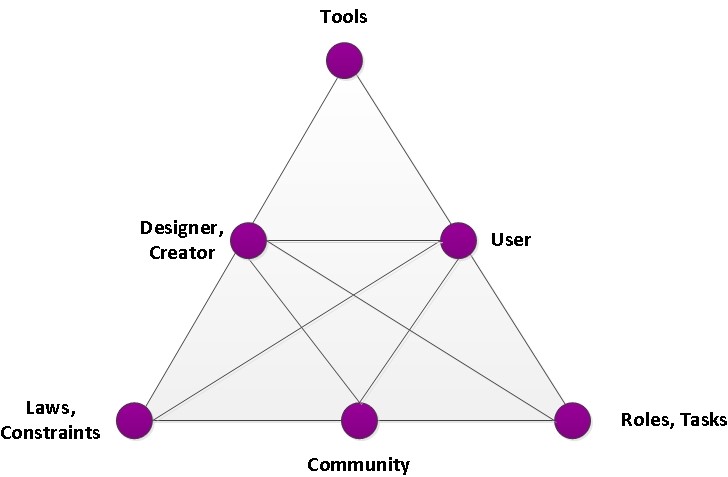
Figure 1 is a simplified example of how activity theory operates with regard to a learner and his or her surroundings. Each intersection on the graph is a major player in activity theory:
The designer/creator is the person or group who is responsible for the project. Without the awareness of his or her audience, the designer could easily alienate or offend the learner, rendering all learning from that interface useless.
The user is the person or group of people that will receive the product that has been created. The user does not operate in isolation, so the user’s community must also be considered. The community is composed of the people who are related to the other elements in the activity theory triangle but are not the intended receiver (Beaumont).
The laws and constraints are parts of the environment that cannot be controlled (such as 24 hours in a day) or the laws or traditions that guide the activity. These constraints include the history of the activities being investigated (Worthen 26).
Tools are the artifacts or objects that are used to mediate the activity. This can be a set of instructions, or in this situation, a computer. A technical communicator often works as a tool designer.
The goal of the activity triangle is to create success for the user — creating a service that is easy-to-use, reliable, and solves a previously unmet educational need.
The Role of Activity Theory in Education
Activity theory posits that every person leaves an imprint on everything in their environment. Any ideals that a designer, educator, programmer or developer might instill their opinions or ideologies into a subject, intentionally or not. The more experience a student has, the more he or she learns through related activity. Learning builds on previously learned information that is relevant to the new learning. This building of knowledge upon experience and previous education is called indexing or scaffolding.
The most universal use for activity theory seems to be analyzing new educational methods. The significance of activity theory lies in its ability to analyze the dynamic human interactions mediated by computers. As Russell explains, “Learning is not a neat transfer of information but a complex and messy network of tool-mediated human relationships that must be explored in terms of the social and cultural practices that people bring to their uses of the tools they share” (Russell 71).
Why Technical Communication and Activity Theory?
Technical communication has so much in common with activity theory that many technical communicators already use some of the principles. Activity theory is an organically evolving learning theory since it constantly changes as people do. Technical communication has several core skills that mesh very well with activity theory:
- audience awareness
- usability/design
- persuasive writing
- instructional writing
- translating information
- collaboration
Activity theory establishes a tiered hierarchy that can be used to analyze an activity: activities, actions, and operations. Purposeful human activity is the highest level on the hierarchy. Repetition of actions can cause the actions to become automatic or unconscious, turning them into operations. Natural human capabilities can be extended by mediating artifacts such as computers that will ultimately allow the individual to attain goals that could not be attained otherwise (Stolley 356).
Collaboration among learners or professionals aids in developing, testing, and evaluating different beliefs and hypotheses within learning contexts. Through the process of articulating covert processes and strategies, learners are able to build new and modify existing knowledge structures (Jonassen et al. 13). Carroll and van der Mejj (1998) suggest that to make instruction manuals more genuine and user centered, the writer must capitalize on users’ interests and previous knowledge. By directly building on their prior skills, knowledge, and experience, the material will be clear and tangible (Carroll 31). This technique shares many of the same principles as activity theory.