
“Strengthening Technical Communication with Educational Theory”
by Penny Bencomo | Xchanges 8.1
Transitioning Education
Education has stagnated with regards to technology. Most teaching is still done face to face in classrooms, and students are evaluated using traditional testing methods. Technology is often used in distance education, but it is underutilized in nearly every other area of education.
Traditional Learning Methods
Conscious learning emerges from the performance of an activity, so that students get more from the material since they are actively participating. Activity theory focuses on the dynamic relationship between consciousness and activity. Traditional learning theories assume that knowledge is a commodity that can be transferred or absorbed; however, it must be learned by whatever method works best for the student (Jonassen et al. 62).
The most valuable activity in a learning environment is the opportunity for students to work and interact together to build and become part of a larger community of scholars and practitioners (Jonassen et al. 7). Traditional concepts of instructional design assume that knowledge can be transferred and acquired by the learners — it is called the sponge method of learning. Educators impart knowledge to the learners, who absorb it like a sponge. During the assessment phase, the knowledge learners should have acquired is wrung out of them. The sponge method is not the most effective method of learning, yet it is frequently used. In the sponge method, knowledge is often passed on using lectures and reading assignments. These methods are ineffective and limit learning in face-to-face teaching environments (Jonassen et al. 7).
Blended Learning
Blended learning refers to a combination of different learning styles — in this paper, it refers to a combination of traditional learning and computer-based learning. Jonassen et al. suggests that technology should be included in curriculum design. By using technology like SmartBoards, Sympodiums, and technology that students already use on a daily basis, teachers can greatly increase the value and have an impact on the students with the material they are sharing.
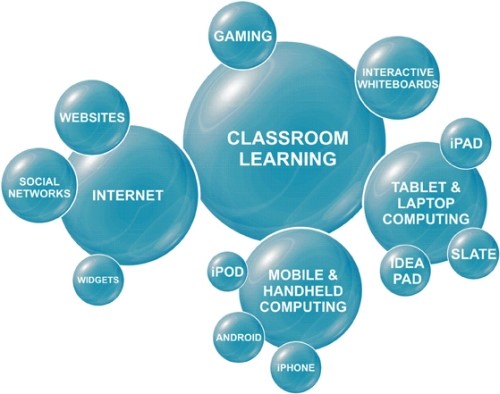
The use of multiple educational approaches, like online collaborative learning, self-paced learning, and in class lectures, has been proven to increase the efficacy of education. Deep and meaningful education can be created by blending these learning techniques.
Dr. David Westpfahl, a physics professor at New Mexico Tech, has a unique and relevant perspective on the use of technology in classrooms. From his experience teaching and using a Sympodium, a Smartboard, and video conferencing, he has made some natural observations that support the argument that blended learning is the future. He is of the opinion that students today have a “digital perspective of the world,” and that “if [educators] make new technology available to [students], they will find new uses for it.” He said that technology is about access — access for the teacher and for the students. Anywhere there is a computer and internet access, someone can perform an experiment or access that environment (Westpfahl).
Technology can be used to supplement teaching and learning in a number of ways. Frederickson et al. listed the benefits as: 24-hour access to vast amounts of information and international resources; information can be explored at depth on demand; different levels of support or scaffolding can be offered simultaneously; and the pace of the interaction can be controlled by the learner (646). There is also a larger range of learning strategies available, such as group discussion outside of the classroom environment, and collaboration is more easily facilitated with technology than in person.
Any new material learned is indexed by the experience surrounding the learning, which assigns meaning to the new material. Information learned in the process of solving real-world problems is much richer and better understood because of knowledge scaffolding. Technology can be used to create communities of learners and practitioners and can facilitate the interactions and activities necessary for solving real-world problems (Jonassen et al. 9).
There are many different methods of teaching via technology. One method, video learning, is presented in many different ways, from YouTube to screencasts to TED (Technology, Entertainment, and Design) conferences. However, not every method of video learning employs activity theory. TED conferences are still lectures — and as previously discussed, lectures are one of the most ineffective teaching methods (Jonassen et al. 7). Screencasting, which is created using capture software with a simple voiceover, is often easier to understand, which means the student learns faster and can use the knowledge sooner.