“Rhetorical Web Design: Thinking Critically about Ready-Made Web Templates and the Problem of Ease”
by Jason Tham | Xchanges 12.1
Analysis of a Template: WordPress.com
To explicate the concerns central to the use and misuse of “easy,” ready-made solutions, this section briefly examines a template design from WordPress.com and its design flexibility. Launched in May 2003, WordPress is a free and open-source blogging tool and CMS based on PHP and MySQL. WordPress is the most popular blogging system in use on the web, with more than 60 million websites (Coalo, 2012).
WordPress offers two kinds of CMS platforms: WordPress.com gives users a free blog but they are not allowed to use it for commercial purposes, while WordPress.org offers a free downloadable file for self-hosted installations. For this analysis, I review template designs from WordPress.com.
I focus this analysis on Responsive Theme, a web design developed by CyberChimp, a third-party web development company for WordPress, available both for free (with limited color schemes and typography) and with a cost of $34.99 (with extended options).
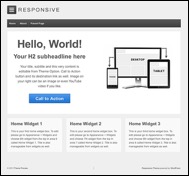
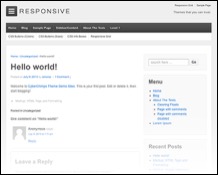
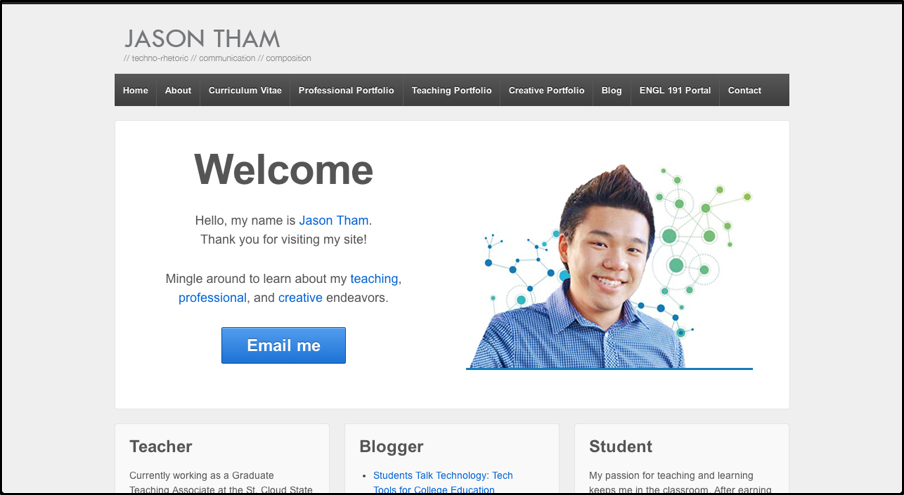
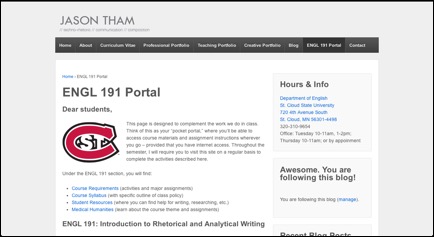
To demonstrate what a user can and cannot do with the template theme, I use a personal example “designed” using the Responsive Theme. With an eye toward my rhetorical intentions and the capacity of the template in helping me achieve those goals, I examine my personal website to uncover the restrictions of locked design in ready-made web templates.
On the landing page, I could not interchange the location of the main menu, nor could I get rid of the welcome panel and replace it with a YouTube video or a running slideshow. While I could certainly control most of the content to publish, the layout of the text panels remained the same. Since I opted for the free version, most of the graphical elements remained in place: the menu bar is always dark grey, the links are always blue, and the text is always a sans-serif font.