“Digital Invention: A Repository of Online Resources for College Composition Instruction”
by Mary K. Stewart | Xchanges 10.2/11.1
Methods
Most students and teachers do not have the time to sift through every university’s online resources, yet there is a plethora of high-quality material available. The following describes my process for locating and selecting the online invention resources on this website.
Selecting Writing Center Websites
I narrowed my search for online invention resources to university writing center websites because (a) I trust that these sites offer reliable resources grounded in composition pedagogy, and (b) narrowing in this way allows me to comment on resources officially sanctioned by the academy. To select the writing center websites (Online Writing Labs, or OWLs), I began with US News and World Report‘s best “writing in the disciplines” colleges. All 17 colleges on the list prioritize the writing process “at all levels of instruction and across the curriculum.”
I focused on seven writing center websites that have distinct sections devoted to online resources:
- Purdue University
- George Mason University
- Colorado State University
- Brown University
- Hamilton College
- Harvard University
- Duke University
- University of North Carolina-Chapel Hill
- University of Wisconsin-Madison
- Dartmouth University
I also emailed each center’s director to better understand their resources. Directors from Purdue, Duke, and Dartmouth responded with helpful information about how content is developed, updated, and disseminated. These responses indicate that the resources available online are often viewed as handouts — electronic equivalents to paper documents used in class or in the writing center. While existing resources may not be very media-rich, exposing students to a digital experience promotes digital literacy by simultaneously teaching computer and composition skills, and by teaching information management through the use of multiple writing center databases via hyperlinks.
Selecting Online Invention Resources
From the 10 writing center websites identified, I selected the online invention resources that were the most clear, most intuitive, and most visually engaging. Because human-computer interaction, usability research, and digital design theory tell us that these characteristics benefit a user’s experience with a website and increase online reading comprehension, I focused my selection process on clarity, intuition, and visual engagement.
My process for selecting and categorizing the resources was as follows:
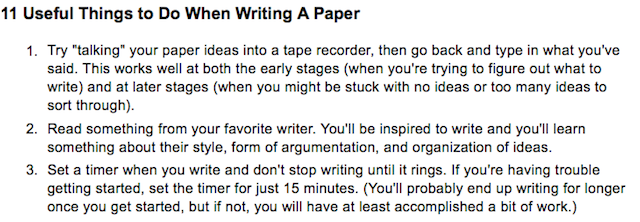
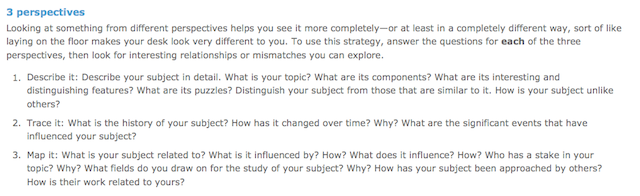
- I first categorized all of the materials as “classical invention,” “prewriting,” or “tagmemic invention.”
- I then categorized the resources as those that define the various invention strategies or those that describe activities for practicing the strategies.
- Once I had compiled a comprehensive list, I used the clear/intuitive/visually engaging criteria to determine which resources would appear on the site and where.