
“Words or Visuals: Which Speaks Louder?”
by Jennifer Heater | Xchanges 8.2
Metafunctions
Harrison, like many other scholars, uses Gunther R. Kress and Theo van Leeuwen’s theory of metafunctions as a framework for analyzing images for their meaning in Western culture. The metafunctions help us create meaning for an image by breaking down attributes of the picture into three different categories and applying them simultaneously to an image. The three metafunctions are representational, interpersonal, and compositional.
Representational Metafunction
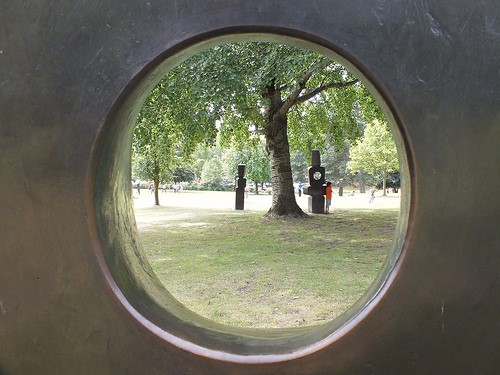
Harrison states, “The representational metafunction is about the people, places, and objects within an image” (50). There are two structures of representational metafunctions: narrative and conceptual. Narrative structures allow the reader to create a story, while conceptual structures present readers with a concept. Figure 3 is a picture from the Flickr photo sharing website taken in Yorkshire Sculpture Park, England. Figure 3 is a narrative, action photograph. There is a vertical vector created by the tree. It demonstrates to the viewer a strong relationship that goes past the hole that is being looked through. Circles are embedded image support — Kress and van Leeuwen explain: “Circles . . . are elements we associate with an organic and natural order. . . The world of organic nature is not of our making, and will always retain an element of mystery” (qtd. in Harrison, 52). Table 1 outlines the basic structures and processes of the representational metafunction.
TABLE 1: REPRESENTATIONAL METAFUNCTIONS BASIC STRUCTURES AND PROCESSES
| Structures | Processes |
|---|---|
| Narrative: Narrative images allow viewers to imagine a story represented by RPs using vectors of motion as base. | *Action: Vectors create the narrative using bodies, tools, trees, roads, and so forth
*Reactional: Eye lines between RPs create vectors. |
| Conceptual: Conceptual images have RPs grouped together to represent a concept of what the RPs represent without vectors. | *Classificatory: Something or some group (same class) or RPs of the same classification. (Ex: NFL Player in advertisement.)
*Analytical: “Part-whole” — The whole is the image and the part consists of the attributes. (Ex: Diagrams) *Symbolic: RPs represent what they mean. (Ex: House icon on web site means home. Triangles, circles, and square shapes are symbolic.) |
Interpersonal Metafunction
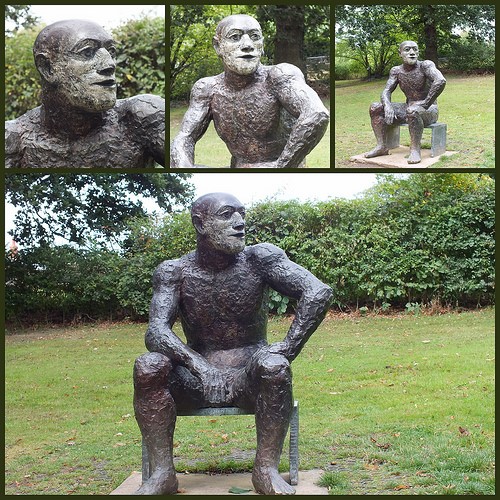
The second metafunction is the interpersonal metafunction, which Harrison explains as “the actions among all the participants involved in the production and viewing of an image” (52-53). Interpersonal metafunctions ask the question “has the image engaged the reader?” Many images use interpersonal metafunctions such as image act and gaze, social distance, intimacy, and involvement to engage the reader. Angles can create power between the reader and the image. Dragga and Voss explain, “We have thus incorporated within the humanistic field of technical communication a technique of visualizing information without adapting that technique to the Humanities, without fully humanizing it” (267). Figure 4 demonstrates several interpersonal metafunctions, showing how perception changes with each image. Table 2 on the following page outlines the basic features and feature processes.