
“Video Social Media: A Reference for Integrating and Applying Video Social Media as a Technical Communicator”
by Danielle Rose | Xchanges 8.1
Literature Review
YouTube and other video social media (VSM) sites allow for various levels of interaction with the video media and the creators of that media. The innovative structure of VSM sites is a large factor of their current popularity and the reason technical communicators should focus more on actively using this technology format. YouTube allows users to comment and rate videos after they have been viewed. Users can also post “responses” to videos.
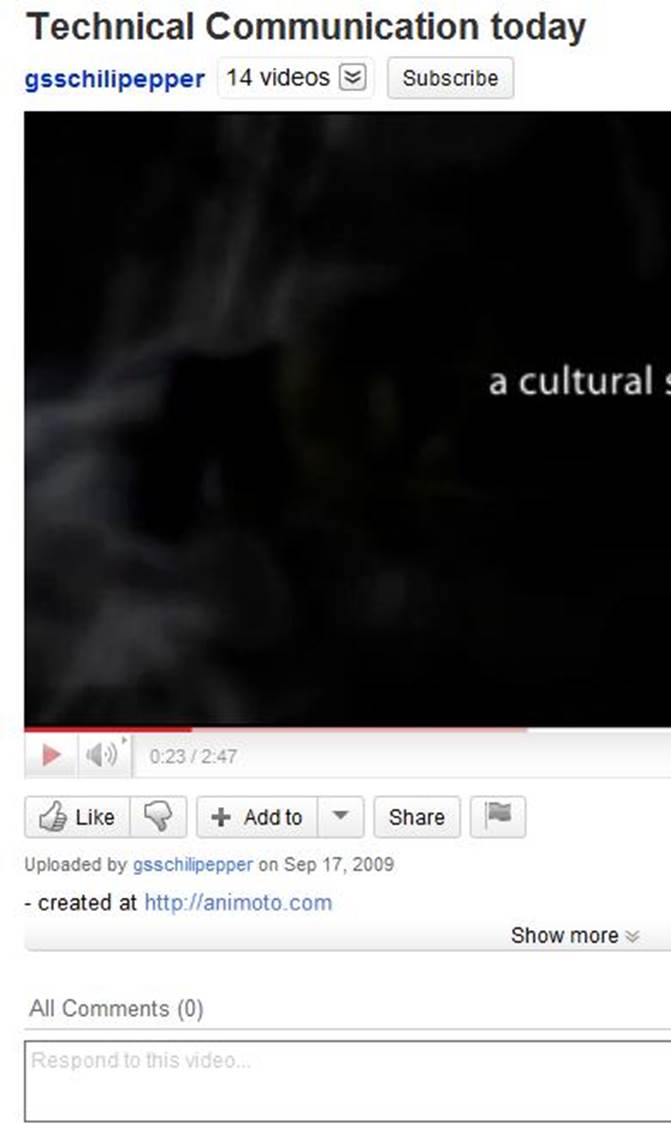
Figure 1, above, shows the YouTube format for interacting with videos. This type of format is common among all VSM sites. The format of VSM sites allows for communication that creates a dialogue between users and video creators, and allows for the spread of information while receiving feedback quickly in an organized format. Enrique Bonsón and Francisco Flores discuss this in their article on social media and its use in corporations, concluding that the metrics for SM sites show that “when you engage in a conversation and treat your consumers with respect and as your peers, magical things will happen” (Bonson and Flores 25).
Rick Cole argues the benefits of social media for public managers, saying that VSM sites allow users to build upon established methods of communication (9). According to articles on integrating social media, like Joyce Lofstrom’s and Britt Parrot’s, as social media reaches new heights, people are looking for ways to incorporate social media into areas like business, hobbies, promotion, politics, etc. Caroline Kealey argues in her article on Web 2.0 that the medium, social media, is also the message. Her main point is that technical communicators need to find new ways of reaching audiences through the arena where “our audiences now live, work, and play,” and VSM sites and SM sites make accessing audiences easier (Kealey 2).
Another advantage of VSM sites is speed. Paper articles tend to address innovations, revelations, and needs within the technical communication community, but they have a lag time between their creation and their dissemination to the public. VSM sites make content viewable instantaneously. Through a video, a user can quickly learn the same information a paper article might have contained, or view changes to documentation that would take weeks, or longer, to print and send out. Viewers can also comment immediately.
Jennifer Sheppard argues for this type of feedback interaction in her article on multimedia production. She says that technical communicators need to fully prepare information for a multimedia audience, and the best way to do this is by working with the audience in several real-time run-throughs (123). VSM sites are the perfect arena for learning through interaction. Guosong Shao explains that users deal with user generated media (UGM) in “three ways: by consuming, by participating, and by producing” (Shao 2). This three-way interaction allows for better communication and involvement with the media and the creators of the media.
James Porter is a prominent voice in the technical communication field and his article on the delivery of digital rhetoric discusses the framework for the delivery of digital information through five key topics (Body/Identity, Distribution/Circulation, Access/Accessibility, Interaction, and Economics) (Porter 207). The video is the body, or the focus, and the VSM site is the method of distribution. Within the distribution there are levels of accessibility and interaction which are the framework and features of the VSM site. VSM sites are a compact delivery system within the definition of Porter’s framework, and VSM sites are constantly adapting. Technical communicators need to adapt themselves to new avenues of digital information delivery.
Adream Blair-Early’s article discusses participatory design research and how methods of design need to adapt, arguing that before technical communicators can move forward “to solve more complex design problems we need a better framework in which to conduct our research” and VSM provides a new framework for technical communicators to work in (Blair-Early 215). A video posted to a VSM site, especially a video that requests feedback and input from viewers, becomes a tool that allows designers (video creators) to learn from their audience and incorporate the information the audience has given them into future creations. By sending a link to a video, a designer can reach employers, employees, and customers — and can reach even farther than that, to potential customers and audiences across the globe.