
“The Ethics of Visual Rhetoric & Photo Manipulation”
by Amber McDonnell | Xchanges 10.2/11.1
Scenario, Cont.
The second photo in this case study seemed to have come under harsher criticism. Unlike the photo of the control room, which was only criticized for careless cutting and pasting, this image of a helicopter flying over the Deepwater Horizon disaster site (Figure 3) has much more to offer in terms of mistakes in alteration.
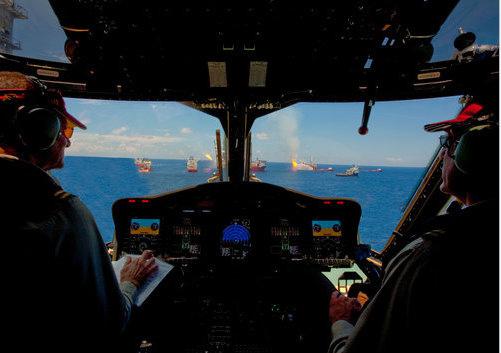
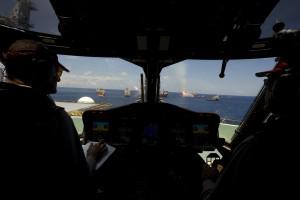
Barrett (2010), writing for Jalopnik, points out that there is either an air traffic control tower or part of an aircraft carrier in the top left corner of the altered photo, indicating that the helicopter was not in the air when the photo was taken. Additionally, Barrett (2010) points out that the dashboard “readouts” indicate that the loading ramp and at least one door are open on the helicopter, the parking brake is engaged, and the pilot is holding a pre-flight checklist. There are also noticeable differences in color between the altered photo and the original, with much brighter colors and blurring and distortion in the center of the image where ships can be seen.
The media scandal that erupted in response to the altered images occurred just over a week after BP received some slightly positive press — a tighter cap on the wellhead on July 15 stopped the flow of oil into the Gulf of Mexico. The scandal also occurred just under a week before BP CEO Tony Hayward announced his resignation. As the images surfaced and circulated in the height of the disaster’s media attention, they played a powerful role in what could have been BP’s big break, but ended up being one of their greatest errors in responding to the tragedy.