
“Health Information Accessibility and Availability and Its Impact on the Health Literacy of Hispanics”
by Jennifer Stone | Xchanges 7.1
Results
After visiting five healthcare provider locations in a mid-sized, Midwestern city and their corresponding websites, health information materials were found to be quite inaccessible (in both English and Spanish) as well as not very available or varied in printed form, demonstrating a shift from printed to online materials. Table 1 provides a detailed summary of the findings of the study. In this table, the available health information at each location is enumerated, described by the topics covered and languages they were available in, and given a subjective number ranking for both ease of access and utility. Ease of access was determined by how difficult it was to find the actual location of the materials within the building or on the internet. Utility was determined by the variety of health topics covered in the available health information at the different locations.
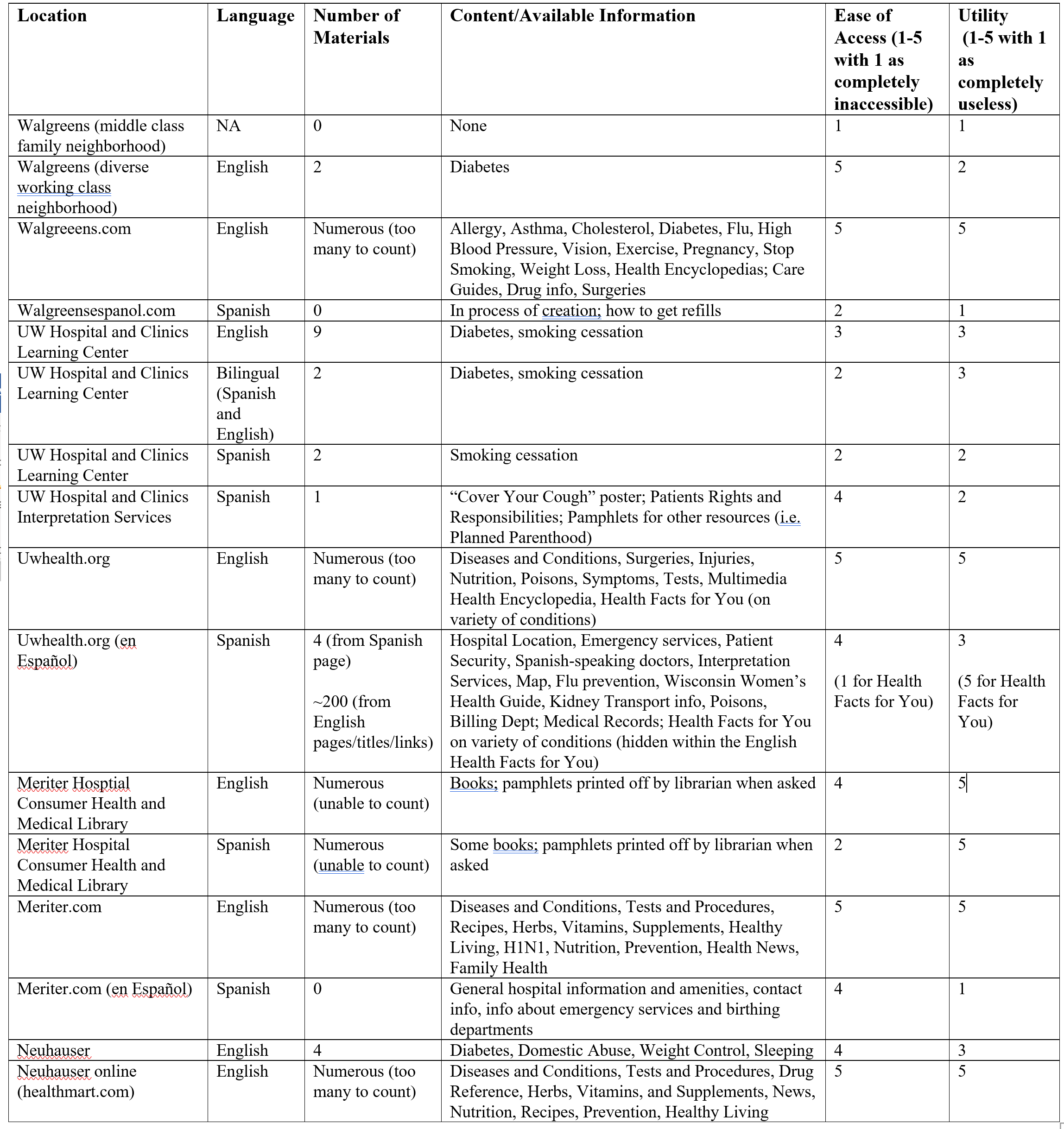
For both Walgreens pharmacies, the health information was searched for by the pharmacy counter. At the Walgreens in the middle class family neighborhood, no health information pamphlets were found. The Walgreens in the diverse working class neighborhood had two health pamphlets in English that discussed the topic of diabetes. On the Walgreens website (walgreens.com), a variety of health and prescription information was available in English. The Walgreens website provided no link to a Spanish version of the website. However, upon searching the keyword “español” within their website, a link was found for a Spanish-language site (walgreensespanol.com). This site contained no information — it simply stated that it was in the process of being created and that if a refill was desired, the person should enter her prescription number and click “refill.”
For Neuhauser Pharmacy, a phone call was first placed to see if any health information pamphlets were available in either English or Spanish. The pharmacist revealed that they had mainly English resources but also a few Spanish resources. Upon arrival at the pharmacy, no health information written in Spanish was found. Four health information pamphlets were found in English that discussed the topics of diabetes, domestic abuse (which was available in Spanish but not present in the pharmacy), weight control, and sleep. Neuhauser Pharmacy does not have its own website, but does have a website through Health Mart (stores.healthmart.com). This website did not contain any health information in Spanish but did contain a wealth of information in English including information on the topics of blood pressure, cholesterol, mental health, nutrition, weight management, stress management, smoking cessation, fitness, and more.
The UW Hospital was called and visited as well. In an initial visit, the researcher was unable to find any health information pamphlets. A couple of days later, the researcher called the main line of the hospital and was eventually transferred to the Learning Center. The UW Hospital website (uwhealth.org) was then visited for information about the Learning Center. No location was given online, but the hours were listed as Monday through Friday from 1pm to 4pm and by appointment. Upon visiting the Learning Center in person, thirteen pamphlets were found outside of the room. All of the pamphlets discussed either smoking cessation or diabetes. Nine of the pamphlets were available only in English. Two were bilingual. There were also two pamphlets available only in Spanish — both about smoking cessation. After finding the Learning Center locked, the Interpretation Services Office was visited for more information. The receptionists there could not definitively say where health resources in Spanish could be found, eventually suggesting the Learning Center or the UW Hospital’s website — a frustrating suggestion given the limited hours of the Learning Center and the lack of Spanish-language information on the website.
The UW Hospital’s website was then visited. An “En Español” link was available on the website’s homepage, leading to information about finding the hospital, emergency services, and a few other miscellaneous links. The only health information available was about kidney transplants, prevention against the flu, and information about poisons. The English version of the website contained pages upon pages of information about a wide variety of health topics. However, upon more searching, other Spanish language resources were found hidden deep within the English website: clicking through “Health Information” → “Diseases and Conditions” → “Health Facts for You” → “Spanish” (all written in English) revealed a list of translated information sheets, but the titles of the sheets were not written in Spanish — only clicking on an English title caused anything in Spanish to appear.
Meriter Hospital’s website was also visited and their Consumer Health Information Library was contacted. The librarian stated that they had books (a few available in Spanish) that could be checked out, or the patient could ask librarians to print off information. Upon looking at their website (meriter.com), a good quantity of health information was found in English, but none in Spanish. From the website’s homepage, an “En Español” tab was found — however, the information listed contained only general information about the hospital and their amenities, with no health information materials at all.